← All OKR examples

Product OKRs: real examples, explained

Great product OKRs are truly outcome focused, going beyond timelines and projects

OKRs are very easy to treat as project management tool and to start putting up project timelines as key results. Great Product teams manage to identify their true outcomes and target those instead, to let the team work on several parallel tracks to achieve the outcomes. Meeting lots of Product teams it becomes quite clear that some teams are strong in this regard while other teams have to work hard to identify what outcomes they are actually driving.

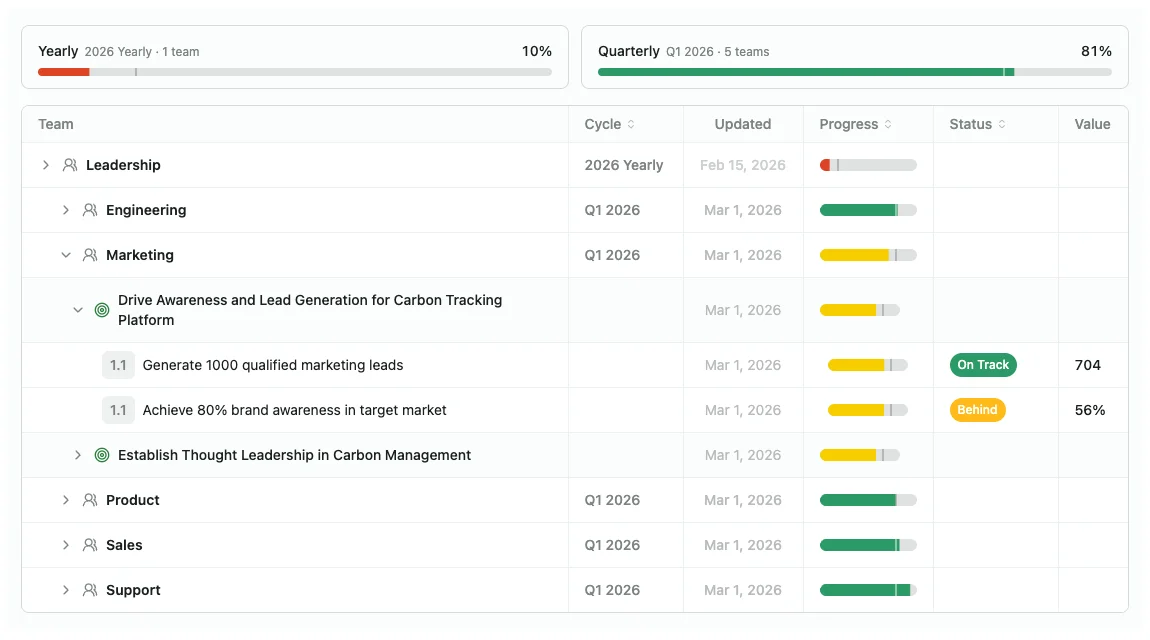
A product team's OKR overview in OKRnest

OKRs for product managers

The roles in a product team will impact both formats and content of OKRs. Where Product managers can bring in real outcomes to their key results, product owners many times have to identify process or more internal metrics.

Objective: Make the first week prove the product's worth

  • Raise week-one activation from 34% to 55%
  • Lift day-30 retention of new accounts from 61% to 72%
  • Cut steps to first key action from 9 to 4

Level: Team Team: Product Company type: SaaS Role: Product manager

Measurable ★★★★★

Outcome-based ★★★★

Focused ★★★★★

Niklas Olsson

Niklas Olsson · OKR coach

This is a strong, measurable, and outcome-based product OKR. The feeling here though is that the team is trying to solve all their issues in one single OKR cycle. It takes on a little too much. When a team looks at an OKR like this and sees they are basically done, that they have covered all their workstreams with one OKR, it is a little too generic, a little too broad, a little too ambitious. They are measuring the right things, but from experience following teams like this, it is very seldom that you actually achieve all of this in one run. It might look like clear, slim focus because it is all about the onboarding process, but the onboarding process is a gigantic topic. It would be more believable, and easier to actually see a change from the work, if it was to make the first week prove the product's worth for a specific niche or kind of customer, or in a specific part of the solution.

There is a good mix here: one and two are clear outcome-focused, while number three is more of an activity, a to-do list item. But it puts up a clear ambition for the change. It is clearly measurable, can drive the right activities, and it is easy to see how number three drives future outcomes. It still works really well as a key result.

Good questions

Are shipped features ever good key results?

It is not uncommon for a timeline or project to take place as a key result, and it is not always wrong. It helps the team stay focused and to discuss what matters in weekly check-ins. If the project can have a 0-100% completion follow-up as well it becomes somewhat measurable and gives data for good discussions.

If the team however starts having lists of projects in the key results, OKRs have become a project management tool and is no longer about goals.

How do product OKRs relate to the roadmap?

A great roadmap is many times derived from business outcomes and goals and OKRs should drive those outcomes. It is not uncommon for OKRs not to mention a word about the roadmap, instead a 'launch new onboarding experience' becomes a 'lower first time usage churn from X to Y' or similar.

Now write yours

OKRnest gives your team the structure these examples are built on, and a weekly check-in habit that keeps them alive. Free for up to 3 users.