


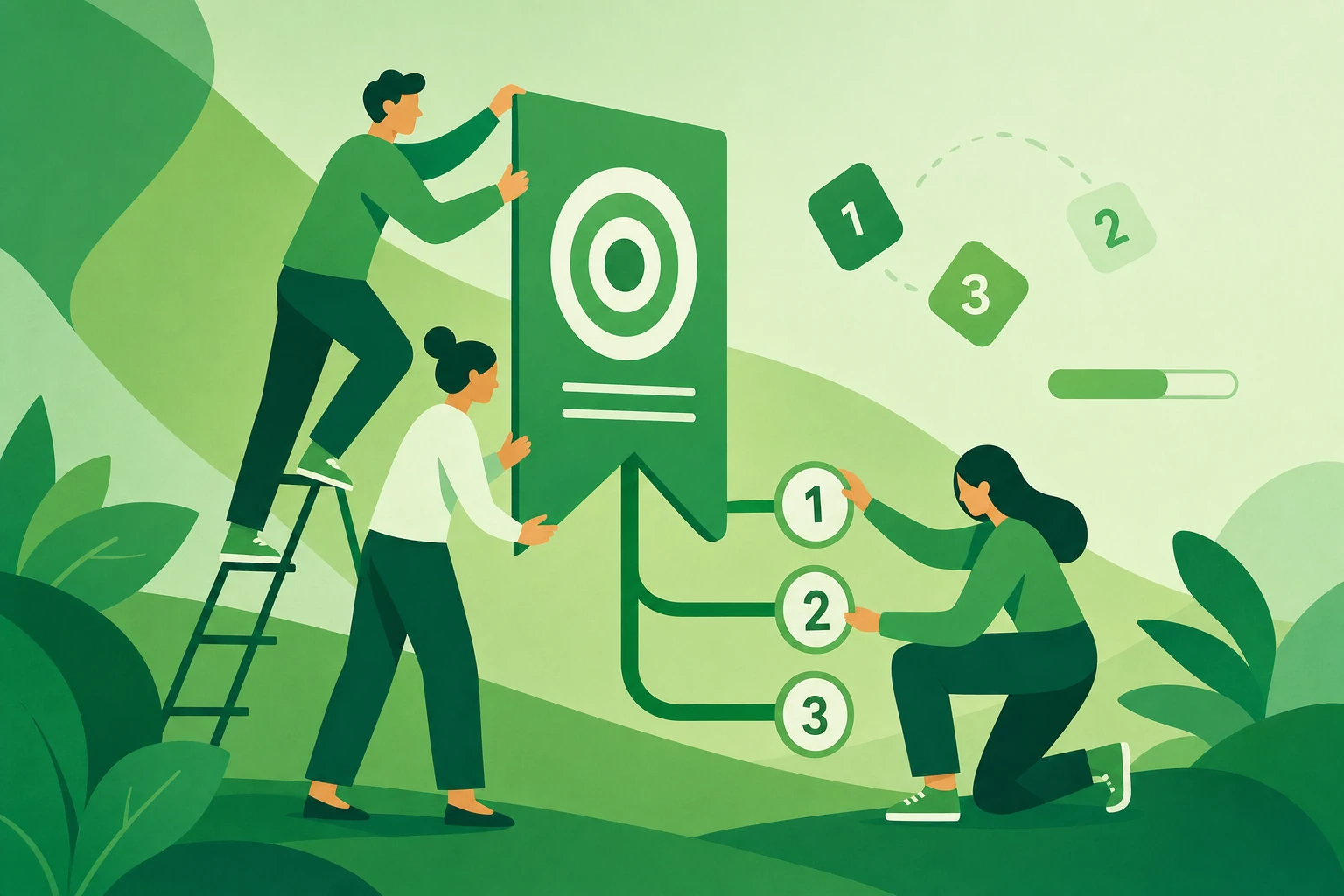
OKRs are really two things at once. They are a smart way to formulate goals, grounded in goal-setting theory and science, and they are also the name of a framework that describes how you work with those goals to turn them into results in your organisation.
The value of working with OKRs is that they can bridge the gap between strategy and execution, while at the same time driving engagement and autonomy in your teams and creating focus and clarity on what is actually important. Well-executed OKRs can become the cornerstone of an organisation’s success.
This article explains what OKRs are without the jargon. We will look at what the letters stand for, how an objective and its key results fit together, how a typical OKR cycle runs over a quarter, why the framework tends to produce different outcomes than ordinary goals, and what the minimum is if you want to try OKRs this quarter.
What does OKR stand for?
OKR stands for Objectives and Key Results. An OKR is a goal with two components: an objective, which is what we want to achieve, followed by a set of key results, which is how we measure that we have achieved it.
The two parts always travel together. A key result never stands alone without an objective, in the same way that you never have an objective without companion key results. That pairing is the whole idea, and it is what separates an OKR from a lone metric on a dashboard or a task buried in a project plan.
Objectives and key results: the anatomy
When we talk about the anatomy of an OKR, what matters is that we capture a complete goal. The objective holds the ambition, the thing we strive for and that speaks to the heart of the team. The key results are the measurable outcomes that tell us whether we got there, and they double as targets that define the level of ambition we have set for this time period.
A good objective should be inspiring, carry strategy, and give direction. A good key result is different in character: it always contains a number, so it is measurable and you can pace yourself towards it through the period. A key result should always strive to be a result, so not an activity, a deadline, or something without a number.
A key result measures a result, not an activity.
"Run four campaigns" is an activity. "Lift customer satisfaction from 4.1 to 4.8" is a result. The framework only works when the numbers describe the outcome you want, not the work that will take you there.
At each level it is common to work with two or three OKRs in parallel, and each objective usually carries two to four key results. These numbers are not written in stone, but a good rule of thumb is the fewer the better, to keep the team’s focus. If you want to go deeper on the right amount, the guide on how many OKRs a team should have covers it, and how to write OKR objectives goes deep on the objective alone.
Here is a simple example of a complete OKR:
Objective Make happy customers the core of our future growth journey
- Increase the customer satisfaction score from 4.1 to 4.8
- Increase quarterly recommendations from 120 to 150
- Improve gross margin from 35% to 38%
Notice that the objective on its own says nothing measurable, and the key results on their own say nothing about why they matter. Together they form a goal you can both believe in and track.
How OKRs work: the cycle
The framework components of OKRs give structure to how we work with goals. OKRs usually live at three levels that work together:
- Strategic OKRs are based in the organisation’s strategy and are commonly set by the management team and for the year. They give a long-term perspective on what is important.
- Tactical OKRs sit with a team or department and describe how they support the strategic OKRs. They give the quarter’s perspective on what matters right now.
- Individual OKRs focus on a single person’s goals. They are less common today, but where they are used they give clarity on a person’s own part in driving the team’s and the organisation’s success.

Around these sit a few rituals, and each one serves a purpose. If you skip one or two of them, you also miss out on the benefit they provide.
We go into a new OKR cycle by creating and setting the OKRs. Once they are written and aligned with the rest of the organisation, we move into check-ins. A check-in is where the team looks at the OKRs and discusses what is needed in the coming period to actually move the needle: what do we need to do to push this target further before the next check-in? Most effective teams run check-ins weekly or every other week to keep their day-to-day work pointed at their goals. (The guide on what an OKR check-in is goes through how to run one.)
As the cycle closes, we make a final calculation of how far we got and run a retrospective around two questions: why did we achieve what we achieved, and miss what we missed; and how did the process of working with OKRs serve us, and how can we do it better next time? Fuelled by the insights from the retro, the team sets new OKRs for the next cycle. Often some carry forward, and sometimes entirely new objectives or key results take their place.
Why OKRs beat ordinary goals
The structure of an OKR forces us to capture both parts of a goal at once: the vision and ambition, and the measurability. Many times when we create goals, we manage only one of the two. A marketing team can set out to run a great event, and then forget to define how it will measure whether the event was great or not. A sales team can be told to sell for a certain amount, and yet nobody specifies the strategy behind it: are we after new customers or repeat orders, and does the strategic agenda make a new market more important than the current one? When the objective is not connected to its key results, there is a real risk that we are measuring the wrong thing, or nothing at all.
This is also where the difference from a KPI becomes clear. A KPI, a key performance indicator, gives you a metric on how something is doing, and you can of course attach a target to it. But on its own it lacks the context of an objective. A useful way to keep them apart is to treat a KPI as a long-term indicator of how something is performing, and a key result as a time-framed ambition to move the needle on a specific metric within this cycle.
You can, of course, run a framework around ordinary goals too. The advantage of using the OKR rituals and the thinking behind them is that you get to learn from the thousands of organisations that have walked this path before you. You do not have to reinvent the wheel on how to work with goals; you start from a well-tried blueprint for turning goals into results, which raises the odds that your own implementation actually succeeds.
The biggest misconception
The most common worry is that OKRs will eat a lot of time, that administering the framework will cost more than the value it returns. In reality it is up to the organisation to decide how much time goes into the framework itself versus working towards the OKRs, and that balance can be tuned to your needs. The more you invest in training and structure, the stronger your success rate and the larger the benefits tend to be. It is equally possible to run a very lightweight implementation and still see real gains quite quickly.
The other big misconception is the reflex of “but we already work with goals”. Most organisations genuinely do. They have budget goals, project goals, team goals, individual goals, and more. What most of them lack is a common language for goals, a shared definition of how to formulate one so that it covers both ambition and measurability, and a structured way of following up and tracking progress. That, rather than the absence of goals, is the gap OKRs fill.
Who OKRs are for, and who should wait
OKRs are strongest where an organisation needs to execute on strategy, which means they are strongest at driving change. Teams that want to improve, work differently, or find new ways of doing things get the most out of them: they get a way to measure change, a forum to define what change actually means, and a clear way to follow up on their progress.

Teams and organisations that are very static, that are content with the status quo and not dependent on improvement, see less benefit at the organisation level. This is not a clean dividing line, though. Even in a static setting, the power of OKRs to create a clear contract between a manager and a team about what matters and what is in focus right now can drive engagement and workplace satisfaction, whatever the strategic agenda.
Getting started this quarter
You do not need much to begin. Start from the definitions of an objective and a key result, and hold on to the idea that key results are results. One of the largest shifts OKRs bring to an organisation is the realisation that, for goals to drive results, the goals themselves have to measure results and not activities.

With that in place, gather the team and discuss what is important to achieve in the coming period. Break the discussion into two or three themes you believe matter most, and let the team put a few measurable results under each. The exercise takes maybe two hours and gives you what we would call draft OKRs.
Aim for good enough to try, not perfect
Do not get stuck on the perfect wording of a goal. What matters is that the goals get transformed into activities in the organisation. Put your real focus on the check-in cadence, and keep those meetings constructive and about the future, not the past.
The exercise itself tends to be the eye-opener. It creates clarity about what is actually important and helps the team line up its everyday work against the metrics you chose together. Accept that perfect goals are hard to write and that moving the needle is hard work; that is simply part of OKRs. They will not appear in an organisation just because people work alongside each other. The framework needs someone to own the process for it to deliver.
If you want to go further once your draft OKRs exist, the broader guide on how to write great OKRs covers objectives and key results together in more depth.
With this starting point, it is time to explore how you get started for real. On OKRnest you will find guides covering most topics around setting and working with OKRs and when you feel ready to try your first OKR cycle, give OKRnest a try and see how it can enhance the process and support you in making your first cycle with OKRs a success!
FAQ
What does OKR stand for?
OKR stands for Objectives and Key Results. The objective is what you want to achieve, and the key results are the two to four measurable outcomes that show whether you achieved it.
What is the difference between an objective and a key result?
An objective is qualitative and sets direction: it should be inspiring and carry strategy. A key result is quantitative: it always contains a number, so it is measurable and acts as a target you pace yourself towards. They always come as a pair.
Are OKRs the same as KPIs?
No. A KPI is best seen as a long-term indicator of how something is performing. A key result is a time-framed ambition to move the needle on a specific metric within a cycle, and it is always tied to an objective that gives it context.
How many OKRs should a team have?
It is common to run two or three OKRs in parallel, with two to four key results each. Fewer, well-chosen OKRs beat a long list, especially for a team that is new to the framework.