← Alla OKR-exempel

Customer success OKRs: real examples, explained

A customer success OKR holds up when it moves retention and adoption, not activity like reviews held.

Customer success sits on the most honest scoreboard in the company: do customers stay and grow? The strongest CS OKRs work backwards from that, into time to value, adoption depth and early risk signals. The weak ones count activity: QBRs held, touchpoints logged, emails sent.

One pattern worth stealing from the examples below: pair every lagging retention number with a leading one the team can move this week. Retention tells you the truth too late to act on it alone.

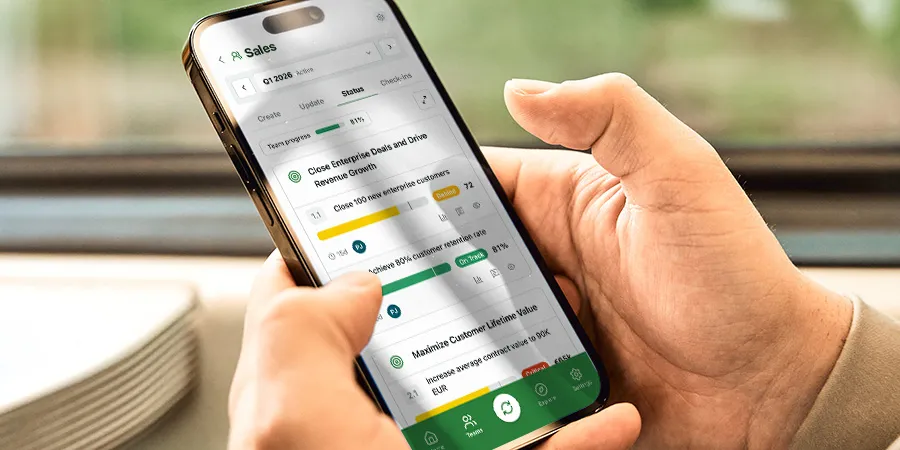
Checking customer health on the go

OKR-exempel för customer success på Team-nivå

Mål: Turn happy customers into proof that wins the next deal

  • Grow referenceable customers from 8 to 15
  • Raise new review-site reviews from 30 to 55

Nivå: Team Team: Customer success

Coachens poäng ★★★★★

Measurable ★★★★★

Outcome-based ★★★★★

Focused ★★★★★

Niklas Olsson

Niklas Olsson · OKR-coach

This is an interesting one. Many times, customer success teams focus on support NPS, response time, or similar. Here it's clear that strategy is involved in this decision, and they're really contributing to a very specific part by focusing on creating recommendations and reviews. I think there's room here for a lot more clarity, however, in the key results. What is a referenceable customer? It probably has an internal definition that should be spelled out there: customers we can ask to support our sales process, for example. Same with the review-site reviews. For clarity in the team, it could almost spell out exactly which review site we are targeting. It would be sharper, and it's much easier to direct effort toward one review site than trying to get reviews in general.

Naturally, add that the reviews should be positive.

Mål: Protect our ARR by seeing churn a quarter away

  • Bring 80% of accounts under a current health score, up from 40%
  • Cut days from risk signal to first intervention from 21 to 7

Nivå: Team Team: Customer success

Coachens poäng ★★★★★

Measurable ★★★★★

Outcome-based ★★★★★

Focused ★★★★★

Niklas Olsson

Niklas Olsson · OKR-coach

This has strong focus for the team, depending on context. If this is a single OKR for the team, to really be able to focus on long-term churn, it's great for creating focus. Key result 1 is unclear from outside the team and might then be unclear inside the team too, in what it actually says. It doesn't define what the current health score is. What would be better is a clear "take them from X to Y", or a variation of this.

There is room for a third key result here to create even more clarity on how the team is approaching this strategic objective. I would say it's almost there, but it needs some adjustment.

OKR-exempel för customer success inom SaaS

Mål: Get every new customer to their first win fast

  • Cut time from signature to first value milestone from 45 to 14 days
  • Raise onboarding completion within 30 days from 55% to 90%
  • Lift 90-day adoption of the core module from 60% to 85%

Nivå: Team Team: Customer success Bolagstyp: SaaS

Coachens poäng ★★★★★

Measurable ★★★★★

Outcome-based ★★★★★

Focused ★★★★★

Niklas Olsson

Niklas Olsson · OKR-coach

Ambitious, and trying to attack the first days of the customer experience from several angles. The main feedback is that it is focused on the first part of the customer journey, but that is still a very broad focus. Each of these individual key results probably has more than a quarter's work in it to really make it move, depending on resources of course. There are also a couple of built-in definitions here: first value milestone, onboarding completion, core module. In cases like this it is extremely important that the team already knows exactly what those mean, so they can work efficiently toward the OKR.

The core improvement would be to take one of the key results and make that the objective, for example get new customers to value quickly through the core module, and then break down two to four key results from that.

Bra frågor

Which customer success metrics make good key results?

Gross revenue retention, time to first value, adoption of the modules that predict renewal, and risk-signal coverage. Each one moves when customers get more value, and none can be hit by simply doing more meetings.

Should CSMs carry revenue key results?

Retention revenue, yes: it is the direct result of the work. New expansion revenue depends on who owns the commercial conversation in your model. If sales closes expansion, give CS the leading indicators, like adoption and health, and let the revenue land where the deal is signed.

Skriv era egna nu

OKRnest ger ditt team strukturen som exemplen bygger på, och en veckovis check-in-vana som håller dem vid liv. Gratis för upp till 3 användare.