← Alla OKR-exempel

SaaS OKRs: real examples, explained

A SaaS OKR holds up when it moves one of the compounding numbers, conversion, retention or expansion, and stays with the team that owns it.

SaaS companies live and die by a handful of compounding numbers: conversion, retention, expansion. That makes them fertile ground for OKRs, and also easy to get wrong when a team chases a metric it cannot actually move. The strongest SaaS OKRs point at a real change in one of those numbers and keep ownership where the levers are.

One test worth borrowing: if a key result would improve simply because the sales team had a good quarter, it does not belong to the team that wrote it.

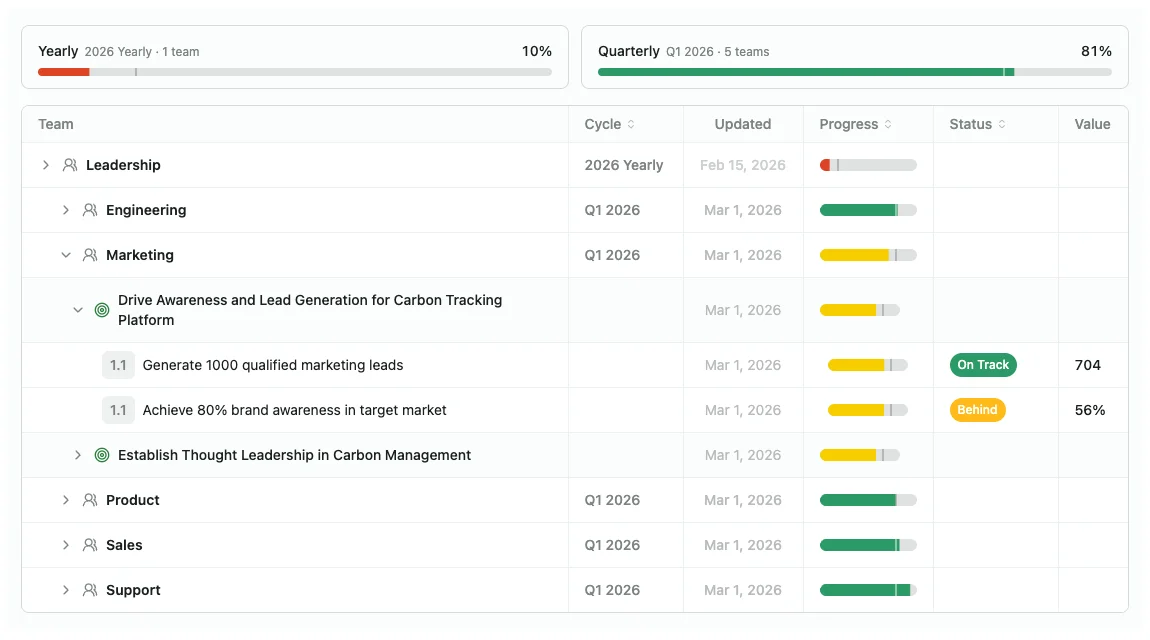
A SaaS team's OKR overview in OKRnest

OKR-exempel för engineering inom SaaS

Mål: Turn incidents from firefights into routine

  • Bring median time to recovery down from 4 hours to 45 minutes
  • Publish a post-mortem within a week for 100% of incidents, up from 40%
  • Reduce repeat incidents from an already-diagnosed root cause from 6 to 1 per quarter

Nivå: Team Team: Engineering Bolagstyp: SaaS

Measurable ★★★★

Outcome-based ★★★★

Focused ★★★★

Niklas Olsson

Niklas Olsson · OKR-coach

This looks like a team with a lot of incidents, and maybe this is their only OKR for the quarter, to really get this part of the work in order. From that perspective it is a good reminder that OKRs are just for the changes you want to achieve. Of course they will do lots of engineering work that is not about incident management, but the core change they need this quarter is how they manage incidents. It is a strong OKR.

The main gap is that the objective could be a little more inspiring, or connect stronger to strategy, to the business, or to the customer. "Turn incidents from firefights into routine" is just the what. An alternative could be something like: enhance our customers' experience of the software through best-in-class incident management. More inspiring, and it makes clear why this matters.

OKR-exempel för SaaS på Company-nivå

Mål: Prove people want this before we scale it

  • Raise week-4 retention of new signups from 18% to 40%
  • Grow paying customers from 8 to 30
  • Reach 40% of users who would be very disappointed without the product, up from 22%

Nivå: Company Bolagstyp: Startup Bolagstyp: SaaS

Coachens poäng ★★★★

Measurable ★★★★★

Outcome-based ★★★★★

Focused ★★★★

Niklas Olsson

Niklas Olsson · OKR-coach

Overall strong, clear, and very ambitious, which is common with startups. Many times startups are exactly the kind of organisation that can really benefit from ambitious OKRs. With a lack of baselines, experts, and experience of what actually works, you can see results that double or triple the current level.

Number three is a fun one: reach 40% of users who would be very disappointed without the product. At the same time it needs some kind of measurability settled up front. Will this be measured at the end of the quarter with a survey to all customers, or is there a better metric for this satisfaction score?

OKR-exempel för customer success inom SaaS

Mål: Get every new customer to their first win fast

  • Cut time from signature to first value milestone from 45 to 14 days
  • Raise onboarding completion within 30 days from 55% to 90%
  • Lift 90-day adoption of the core module from 60% to 85%

Nivå: Team Team: Customer success Bolagstyp: SaaS

Coachens poäng ★★★★★

Measurable ★★★★★

Outcome-based ★★★★

Focused ★★★★

Niklas Olsson

Niklas Olsson · OKR-coach

Ambitious, and trying to attack the first days of the customer experience from several angles. The main feedback is that it is focused on the first part of the customer journey, but that is still a very broad focus. Each of these individual key results probably has more than a quarter's work in it to really make it move, depending on resources of course. There are also a couple of built-in definitions here: first value milestone, onboarding completion, core module. In cases like this it is extremely important that the team already knows exactly what those mean, so they can work efficiently toward the OKR.

The core improvement would be to take one of the key results and make that the objective, for example get new customers to value quickly through the core module, and then break down two to four key results from that.

OKR-exempel för product inom SaaS

Mål: Make the first week prove the product's worth

  • Raise week-one activation from 34% to 55%
  • Lift day-30 retention of new accounts from 61% to 72%
  • Cut steps to first key action from 9 to 4

Nivå: Team Team: Product Bolagstyp: SaaS Roll: Product manager

Measurable ★★★★★

Outcome-based ★★★★

Focused ★★★★★

Niklas Olsson

Niklas Olsson · OKR-coach

This is a strong, measurable, and outcome-based product OKR. The feeling here though is that the team is trying to solve all their issues in one single OKR cycle. It takes on a little too much. When a team looks at an OKR like this and sees they are basically done, that they have covered all their workstreams with one OKR, it is a little too generic, a little too broad, a little too ambitious. They are measuring the right things, but from experience following teams like this, it is very seldom that you actually achieve all of this in one run. It might look like clear, slim focus because it is all about the onboarding process, but the onboarding process is a gigantic topic. It would be more believable, and easier to actually see a change from the work, if it was to make the first week prove the product's worth for a specific niche or kind of customer, or in a specific part of the solution.

There is a good mix here: one and two are clear outcome-focused, while number three is more of an activity, a to-do list item. But it puts up a clear ambition for the change. It is clearly measurable, can drive the right activities, and it is easy to see how number three drives future outcomes. It still works really well as a key result.

Bra frågor

Which SaaS metrics make the best key results?

Rates over totals, as a rule. Trial conversion, net revenue retention, activation rate and churn keep their meaning as the company grows, and they expose real change instead of riding on traffic. Totals like signups or MRR have their place at company level, where the whole system is the unit being measured.

How do SaaS OKRs differ by company stage?

Early on, most objectives orbit one question: do people who try the product stay? So activation and retention dominate. Once retention holds, the centre of gravity moves to expansion and efficiency. The classic misstep is an aggressive acquisition OKR on top of leaking retention: it spends the company's focus where the leak is not.

Skriv era egna nu

OKRnest ger ditt team strukturen som exemplen bygger på, och en veckovis check-in-vana som håller dem vid liv. Gratis för upp till 3 användare.