

 WorkBoard
WorkBoard screenshots
Who it fits
- Tool type
- Dedicated OKR tool
- OKR experience fit
- Advanced / at scale
- Orientation
- Leadership-led (top-down)
- Team size
- Enterprise
Pricing
- Free plan
- No
- Free trial
- Not disclosed
- Price band (per user/mo at 25 users)
- Quote only
- Pricing model
- Quote only
- Pricing transparency
- ★★★★★
- Monthly billing
- Not disclosed
No public pricing, enterprise sales only.
Product & integrations
- Slack
- Yes
- MS Teams
- Yes
- Jira
- Yes
- API
- Included
- Native integrations
- Not disclosed
- Mobile app
- Not disclosed
- AI maturity
- ★★★★★
WorkBoardAI generative features plus purpose-built agents; vendor describes agentic capability, autonomous multi-step action not independently verified.
Security & compliance
- SSO
- Paid tier only
- EU data hosting
- No
- SOC 2
- Certified
- ISO 27001
- Certified
Company & reviews
- Company HQ
- United States
- Vendor stability
- ★★★★★
- Ownership
- Investor-backed
- G2 score
- 4.7 (103 reviews)
Mid-consolidation absorbing Quantive; last funding round 2021.
Compared with OKRnest
- WorkBoard and OKRnest occupy opposite ends of the category.
- WorkBoard is bought by executives and rolled out top-down across enterprises; OKRnest is adopted by a single manager and grows bottom-up from the team.
- An enterprise running a C-suite operating model will shortlist WorkBoard; a smaller team or SMB team that wants the OKR habit without procurement cycles, quote-only pricing or a top-down rollout starts with OKRnest today, hosted in the EU.
Solution overview
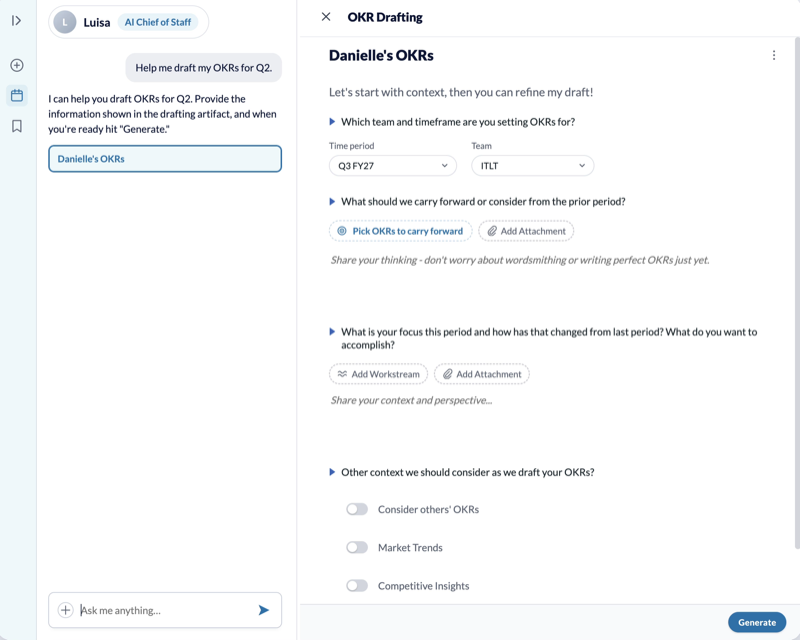
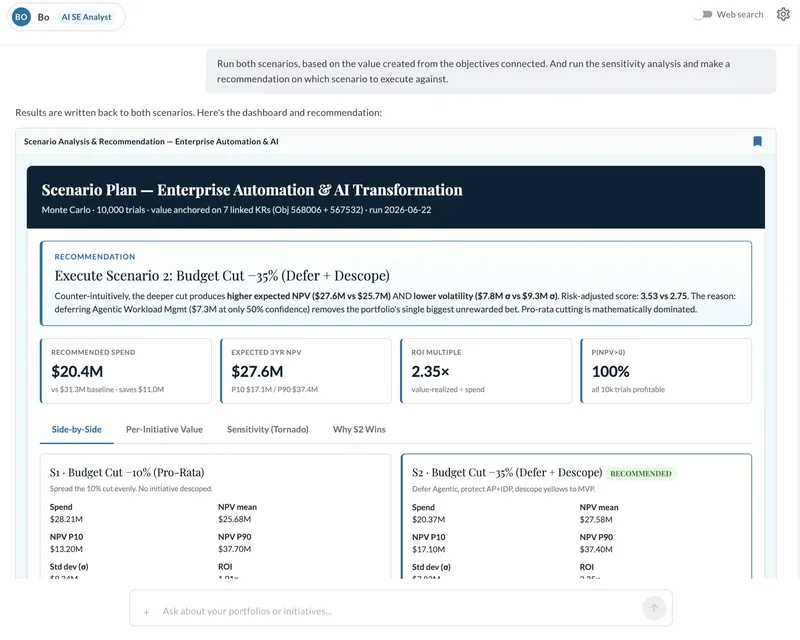
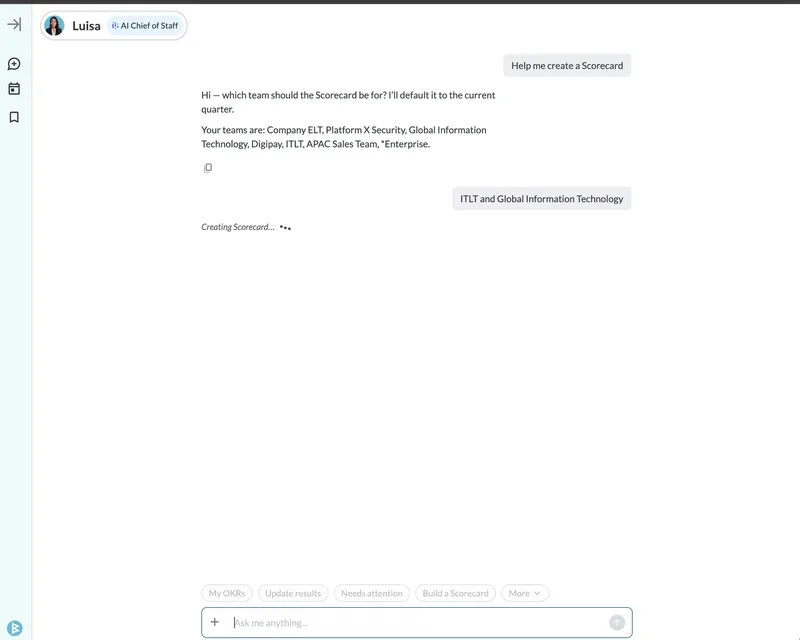
WorkBoard is the enterprise consolidator of the category: a US strategy-execution platform (~$140M raised, valued ~$725M in 2021) that acquired Quantive in 2025 and serves Fortune 500 logos like Boeing, Cisco and Capital One. Its pitch is AI-native execution at scale, with purpose-built agents (Chief of Staff, Leadership Coach, Portfolio Analyst) on top of an enterprise knowledge graph spanning strategy, OKRs, portfolios and performance.
Its reach is growing as Quantive's customer base folds in, and it holds SOC 2 Type 2 with deep Jira, Salesforce and Workday integrations. Everything about it is top-down: quote-only pricing, leadership-led rollouts, no self-serve, no EU hosting, plus integration risk while absorbing Quantive.
The default choice for C-suite-driven OKR programs at large enterprises, and the opposite of a team-led tool.
Strengths
- Enterprise AI-native platform with purpose-built agents (Chief of Staff, Leadership Coach, Portfolio Analyst) and a Fortune 500 customer base (Boeing, Cisco, Capital One).
- Strong momentum after absorbing Quantive, SOC 2 Type 2, deep Jira/Salesforce/Workday integrations.
Weaknesses
- Enterprise-only, quote-only pricing and a leadership-led top-down model; no self-serve path and no EU hosting.
- Mid-consolidation risk while integrating Quantive, and the last funding round was 2021.
What customers say
Reviews are positive and enterprise-flavored: users value centralized goal tracking, global visibility across large organizations, strong customer support and the newer AI features such as generated briefs and OKR drafting. The consistent criticism is complexity: a steep learning curve for beginners, an interface that takes time to master, and flexibility that can confuse new users and even hinder OKR methodology adoption.
Occasional bugs in scorecards and navigation rough edges also appear. The picture fits its positioning: powerful at scale, demanding for newcomers.
How they position themselves
“Align & Drive Outcomes at AI Speed.”
The enterprise system of record for strategy, OKRs, portfolios and performance, orchestrated by AI agents for the C-suite.
Sources
Every data point above was checked against a primary source, last verified 2026-07-19.
Compare every OKR tool side by side
This comparison is compiled in good faith and kept up to date as best we can, but it may still contain errors or be out of date. Spotted something wrong? Let us know and we will fix it.