

 Weekdone
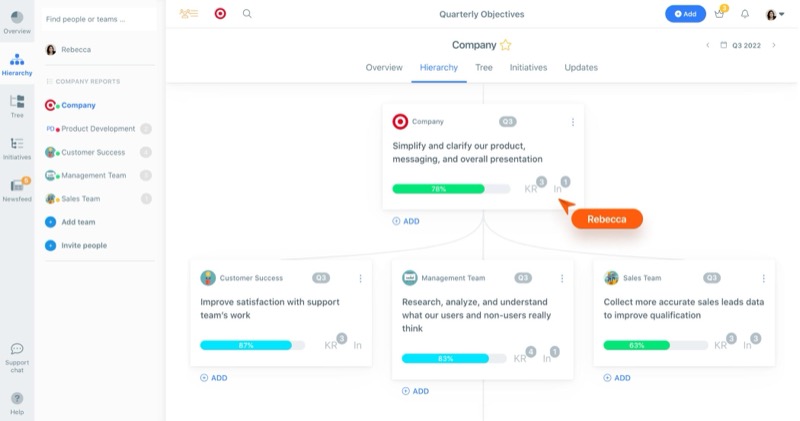
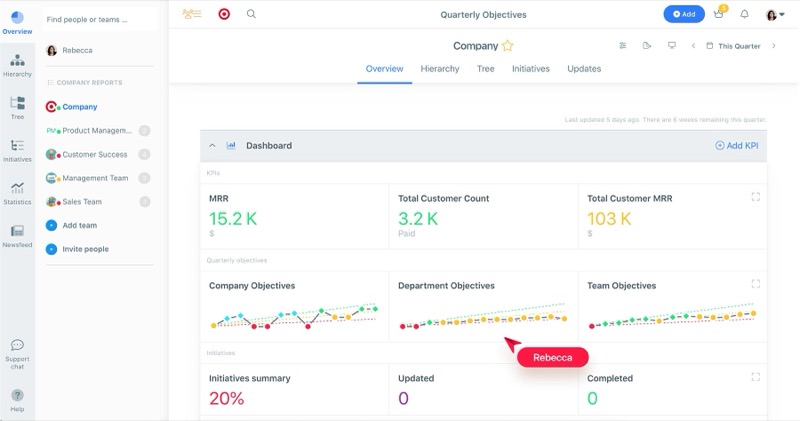
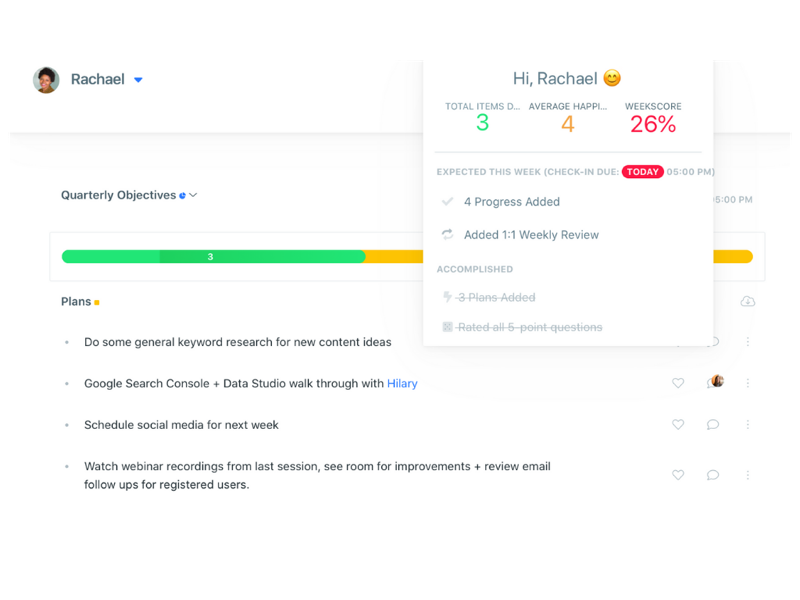
Weekdone screenshots
Who it fits
- Tool type
- Dedicated OKR tool
- OKR experience fit
- New to OKRs
- Orientation
- Team-led (bottom-up)
- Team size
- Startups
Pricing
- Free plan
- Yes
- Free trial
- Yes, no card needed
- Price band (per user/mo at 25 users)
- Mid ($5–$10)
- Pricing model
- Per user
- Pricing transparency
- ★★★★★
- Monthly billing
- Yes
- Published plans
-
Free 3 seats includedStandard (small) then USD 10.80/user/moStandard (scaled) then USD 7.20/user/mo
Sliding per-user scale; figures approximate from the public calculator.
Price structure public, but the real per-user price only via calculator.
Product & integrations
- Slack
- Yes
- MS Teams
- Yes
- Jira
- Yes
- API
- Included
- Native integrations
- 8 native, including Asana, Basecamp, Google
- Mobile app
- Native app
- AI maturity
- ★★★★★
No first-party AI features found.
Security & compliance
- SSO
- Included in all plans
- EU data hosting
- Yes, standard
- SOC 2
- Not certified
- ISO 27001
- Not certified
Company & reviews
- Company HQ
- Europe
- Vendor stability
- ★★★★★
- Ownership
- Independent
- G2 score
- 4.2 (36 reviews)
Bootstrapped and running since 2012.
Compared with OKRnest
- Weekdone and OKRnest are built on the same conviction: the weekly team rhythm, not the goal tree, is what makes OKRs stick.
- Weekdone has proven since 2012 that the model works, but it ships no AI and its product pace has visibly slowed.
- OKRnest offers the same habit-first approach as a modern, AI-native product, a natural fit for teams that want this philosophy with today's tooling.
Solution overview
Weekdone is the veteran of the category: an Estonian, bootstrapped dedicated OKR tool running since 2012, built entirely around the weekly PPP rhythm (Plans-Progress-Problems) with quarterly OKRs on top. It is small-team friendly (free up to 3 users), EU-hosted in Tallinn, has native mobile apps and an independent owner.
The product has aged: there are no AI features at all, certifications are absent and the review base is small (~36 on G2). It proves the durability of the habit-first model.
Best fit today is a small company that wants a simple, proven weekly reporting routine and nothing more but the lack of current updates and developments is a red flag.
Strengths
- The weekly PPP rhythm (Plans-Progress-Problems) is the heart of the product, making it one of the few tools where the check-in habit is truly core.
- Bootstrapped and running since 2012, free up to 3 users, EU-hosted (Tallinn) with native mobile apps.
Weaknesses
- No first-party AI features at all, and the pace of product development has visibly slowed.
- Real per-user pricing is only visible via a calculator, certifications are absent, and the review base is small (~36 on G2).
- It is indicated that Weekdone is not currently in active development.
What customers say
Reviews are broadly warm but noticeably dated, with most written years ago and the review flow now slowed to a trickle. Users consistently like the ease of use, weekly reporting rhythm, transparency across teams and the strong coaching support.
Recurring complaints are pricing that feels expensive for small teams, time-consuming initial setup, a laggy mobile experience and the ongoing struggle to get whole teams using it consistently. The pattern matches a mature product whose momentum has faded.
How they position themselves
“Goal Alignment & Progress Reporting Made Simple.”
Quarterly OKRs plus weekly updates for leaders of growing 20-40+ person companies: simplicity, transparency and a steady weekly reporting habit rather than enterprise strategy tooling.
Sources
Every data point above was checked against a primary source, last verified 2026-07-19.
Compare every OKR tool side by side
This comparison is compiled in good faith and kept up to date as best we can, but it may still contain errors or be out of date. Spotted something wrong? Let us know and we will fix it.